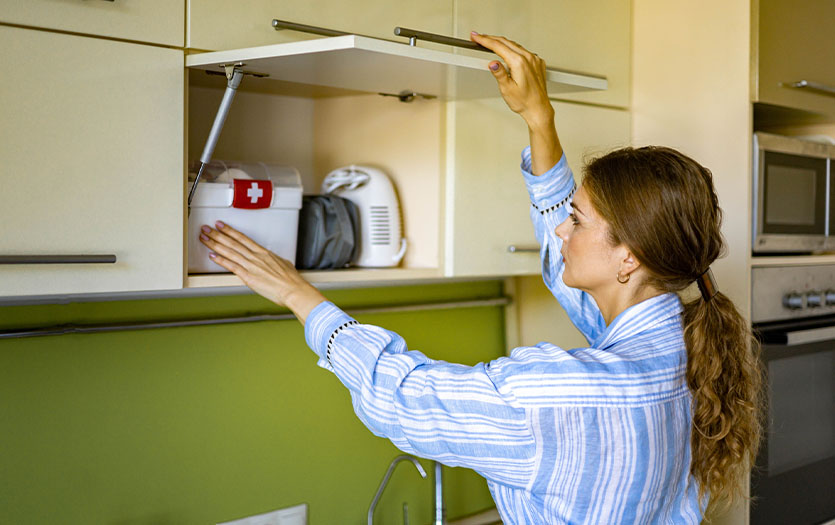
More of your health care takes place in your home than anywhere else. When you or someone in your family is feeling under the weather, the last thing you want to do is bundle up and drive to the store. Having the right tools, medicines, supplies and information on hand for any scenario will make taking care of yourself much simpler and less stressful.
Setting up your cache
Store all your medical self-care tools and supplies in a central location, such as a large drawer, cabinet or closet in the bedroom or family room. When choosing your organization method, keep in mind that some medications and supplies have specific storage requirements. To maintain the integrity of your inventory, aim for a clean, dry environment that is free from humidity and direct sunlight. If small children are around, keep your supplies out of reach or stored in containers or cabinets with childproof safety latches.
Among your supplies, keep a copy of all your family's medical records in one secure place so they're easy to find when needed in a pinch. Consider using a file organizer with labeled slots or folders for each family member's paper records. For digital access, MyChart makes it simple to view or download your medical information.
Learn how to get a copy of your records here.
Be familiar with the disaster preparation and response plan for your area and keep essential contact information close by. This could include your primary care doctor, pharmacy and local emergency responders. Don't forget to post the poison control phone number (1-800-222-1222) in a location where all of your household members or visitors can easily find it.
Keep the appropriate supplies on hand
Now that you've got your preferred system of organization in place, it's time to fill it up! Here are some items that you might want to add to your cart:
Temp check. Depending on the age and needs of the people who live in your home, you may need different types of thermometers.
-
Electronic
-
Ear
-
Temporal artery
-
Disposable
-
Forehead
-
Pacifier
Not sure which you need? Find additional guidance from an infectious disease expert in this video: Temperature checking 101.
Ear exam. No one is happy when they have an earache. Save yourself the tears and stress of juggling a fussy toddler, phone camera or flashlight to get a better look. An otoscope is a handheld device fitted with a light, a magnifying lens and a funnel-shaped viewing piece to help you see in the canal. If you see an object in the ear, do not move the otoscope forward or try to remove the object. Seek medical help.
Pillbox and splitter. A pillbox has lots of small compartments to organize your pills for each day of the week or month. Some medications can look similar. Consider leaving at least one pill in the original packaging so you know exactly where it came from. For some, large tablets can be difficult to swallow. A pill splitter makes it easy to cut the medicine in half precisely.
Medicine spoon. Most over-the-counter liquid medications come with a measuring cup, but medicine spoons can be particularly helpful for individuals with small children. The transparent tubes are marked with typical dosage amounts, which makes it easy to give the right dose of liquid medicine without spilling.
Humidifiers and vaporizers. These devices add moisture to the air, making it less drying to your mouth, throat and nose.
-
A humidifier blows cool to lukewarm mist into the air and is often safer for children, but must be cleaned and disinfected regularly.
-
A vaporizer puts out hot steam and is germ-free. It may feel good when you have a cold, but the hot water can burn anyone who overturns or gets too close to the device.
For individuals with asthma or other respiratory conditions, consult your healthcare provider to determine if a nebulizer can help alleviate your symptoms.
Cold and hot packs. A cold pack is a plastic envelope filled with gel that remains flexible at very cold temperatures. Buy two reusable packs, and keep them in the freezer so you can swap them out when one becomes too warm. A bag of frozen vegetables will also work as a cold pack, or you can make your own:
-
Mix 3 cups (710 mL) of water and 1 cup (237 mL) of rubbing alcohol in a freezer bag.
-
Seal the bag and place it in the freezer until slush forms.
-
Refreeze the bag when the slush melts.
A heating pad or microwavable hot pack filled with gel or with grains, such as wheat or rice, can also provide relief for muscle aches or injuries.
Honorable mentions. In addition to standard first aid supplies, consider also having:
-
Extra batteries
-
Activated charcoal
Final thoughts
The items that go in your home health center should reflect and adjust to the needs of those in your household. Every few months, remember to check expiration dates and dispose of any outdated or unused medication items safely.
While most common ailments can be addressed at home, if your symptoms do not improve within a few days or worsen, reach out to your primary care provider to help decide whether a physical appointment or virtual care visit is the next best step.
Copyrighted material adapted with permission from Healthwise, Incorporated. This information does not replace the advice of a doctor.