To mark Colorectal Cancer Awareness Month, we asked Praveen Sateesh, MD, to answer our questions about the most effective screening options for early detection.
Why is a colonoscopy still considered the most thorough and trusted colorectal cancer screening option?
Colonoscopy is the most sensitive screening test for detecting colon cancer and colon polyps. It also allows doctors to remove polyps during the exam, which can help prevent them from turning into cancer. This makes colonoscopy a powerful tool for both early detection and prevention.
If a colonoscopy isn’t right for me right now, what other effective screening tests can still protect my health?
Cologuard® is the main screening option outside of colonoscopy. A positive result from this stool test means a follow-up colonoscopy will be needed.". Unfortunately, it has poorer sensitivity at detecting colon polyps than colonoscopy. Because it can miss colon polyps, its ability to prevent cancer is more limited. By the time the test is positive, colon cancer may have already developed. Cologuard is not approved for use for anybody with a family history of colon cancer, a genetic cancer syndrome or history of colon polyps.
Colonoscopy is the gold standard, but Cologuard can be an option for screening in average risk individuals as long as they understand its limitations compared to colonoscopy in colon cancer prevention.
How do all the endorsed colorectal screening tests compare in terms of accuracy, comfort and convenience?
The following table details these results:
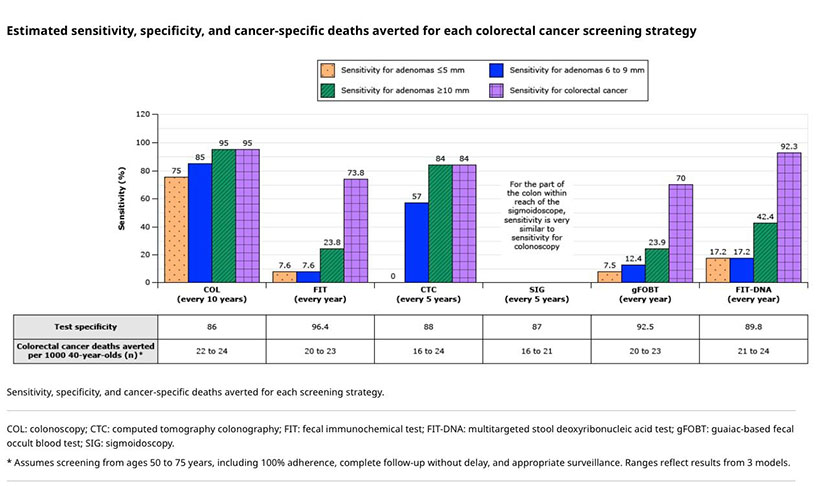
The first column is colonoscopy – Best accuracy for detecting colon cancer and colon polyps. This requires prep and the procedure, so it’s the least comfortable and convenient.
The 4th column is flexible sigmoidoscopy – This only examines about 25-30% of the colon. This requires prep and the procedure, so it has the same level of comfort and convenience as the colonoscopy. Today, colonoscopy is generally preferred to over this option
The 3rd column is CT colonography – This is a CT scan test with poorer accuracy than colonoscopy in detecting colon polyps and colon cancer but still better than the other stool-based tests. This test requires preparation and is usually used only when a colonoscopy cannot reach the entire colon due to anatomy.
The 6th column is Cologuard – While this option works well for detecting colon cancer, it is much less accurate at finding colon polyps than a colonoscopy. This is the most comfortable and convenient as it is just a stool test and does not require prep or procedure. A positive test result requires a colonoscopy, however. This is also not approved for those with a family history of colon cancer, history of colon polyps or genetic cancer syndromes.
The other two tests (2nd and 5th columns) are similar to Cologuard in that they are stool tests which offer the same comfort and convenience as Cologuard, however, they are not as accurate and far less accurate than colonoscopy.
Colonoscopy is the gold standard and should be offered above all other screening tests for colon cancer screening.
What makes colorectal cancer preventable?
Changing certain lifestyle factors can help, such as quitting smoking. However, in many cases, colon cancer occurs in average risk individuals without any risk factors. Age-appropriate colon cancer screening with colonoscopy is the best way to prevent colon cancer.
Are there certain populations you would or wouldn’t recommend the different types of screenings to?
For those with family history of colon cancer, history of colon polyps (from a previous colonoscopy) or genetic cancer syndrome, the only approved method for screening is colonoscopy.
How can a patient approach this conversation with their physician?
It typically starts with their primary care physicians, who can then refer the patient for a colonoscopy for screening at the right age.
How can someone schedule these tests?
The patient will get a referral through their primary care physician and then are contacted by our office to schedule. In some situations, self-scheduling via MyChart may be possible.
Talk with your primary care provider today to find out which method is best for you.
To schedule a colonoscopy with the Parkview Colon Screening Clinic, call 260-266-9085 or schedule via MyChart.