After Emily Hammond, BSN, RN-BC, trauma research coordinator, Parkview Health, suffered life-threatening injuries from a motor vehicle accident, she woke up with a deep sense of gratitude for those who helped rescue her. What she didn’t know then, was that her story would be part of the inspiration for a new program, dedicated to reuniting trauma patients with first responders.
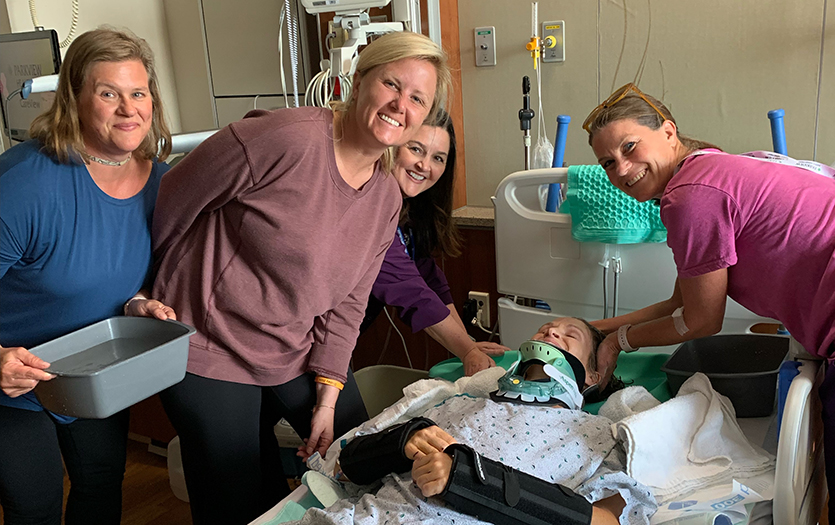
“When I woke up in the hospital and was more alert, I wanted to know who these first responders were that helped me because I wanted to thank them,” Emily said. When they did show up for a reunion, it wasn’t quite what Emily had imagined. “If you had to draw a picture of a firefighter, you would probably draw this giant muscular person. When he walked in and saw me, that I was okay, he just broke down, and we hugged. We took a picture, and that just meant a lot to me because I wanted to make sure he was okay, too.”
As Emily learned, healing often begins when two people who shared a trauma come together.
Full-circle connection
While Emily was recovering from her hospital stay at a local nursing home, one of the nurses, who was also a friend of Emily’s, asked if someone could visit. “She told me Dr. [Mark] O'Shaughnessy was there and asked if I’d mind if he came in. I was telling him about this full circle moment, and he was like, ‘Emily, this is so crazy. The only reason why I knew about your accident is because I had met with that same firefighter, and he showed me the picture you guys took.’”
Dr. O’Shaughnessy shared a bit about his work advocating for first responders’ heart health, and he and Emily agreed that mental health was a factor. “I was talking to him about wanting to create an easier way for people to meet the people that helped save them and he told me was working on that with Trauma Services.”
Sarah Hoeppner, adult trauma program manager, Parkview Health, didn’t know about Emily’s meeting with Dr. O’Shaughnessy when she hired Emily as her trauma research coordinator, but she felt strongly that Emily’s personal and professional experience made her a valuable asset to the trauma team.
“Dr. O'Shaughnessy had reached out to me and had asked that the trauma program help with post-traumatic stress disorder development in first responders,” Sarah recalled. Which, of course, she agreed to. “He told me, ‘I have a friend that was a patient of yours who had difficulty just wanting to tell the first responders thank you for the care that they provided.’ Fast-forward about two months, we hired Emily, and I included her on a meeting to further discuss the program with Dr. O’Shaughnessy. Come to find out who he was talking about was Emily, who I interviewed was Emily, and she had no idea that I was talking with Dr. O'Shaughnessy, because she thought it was probably a trauma doctor. So, our whole circle came together, and this is also why we called it the Full Circle Moment.”
Grateful first responders
“We feel pain. We feel sad for these families that have to go through the unthinkable,” Chad Martin, BSN, flight paramedic, Parkview Samaritan, said. “For us, I think it makes us feel a lot better. We feel like we impacted this patient's life, whatever it may be, whatever situation, we were able to make a difference in their day. What was likely the worst day for them. It's comforting for us, because we do see a lot of bad, but we also like to see the good. And this does impact our lives, the stuff we see and do. “
Jon Hoeppner, BSN, flight paramedic, Parkview Samaritan, agreed. “I feel like the Full Circle's an important program, not just for the Samaritan program, but first responders, EMS, police, fire. I'd have to say it's probably less than 1% of the patients that you treat come back to you. There's not an outlet to connect to you as the first responder or the flight nurse. And the circle back we would get back at that timeframe would be get the letter when the patient was discharged from trauma services. And that kind of made you feel good about how the call went, what happened with the patient, but you weren't necessarily meeting the patient. So, with the Full Circle program now, there's a contact point for people to hopefully make that connection. And then you can tie in that outcome with that patient to see how they're doing, and you can recall that call and then tie in a good memory with that, that this person has made it and is moving on in life.”
“It's two different shared experiences,” Sarah said. “And in the hopes of this is to improve mental health for both. And it was Emily's story that helped me see that.”
Only getting started
Sarah shared that she has broadened Emily’s role to include the Full Circle Moment as well as other trauma survivorship offerings. “When she said what her first responder and herself were able to discuss together, they were able to grow together, and I would like to do that for others,” Sarah said.
For her part, Emily is thrilled to support these efforts. “I just want to keep this going and help everyone in whatever that means, whether it's figuring out what happened in your accident to help you heal, whether it's the first responder going, ‘Wow, they're okay. I can let that go,’ and just have better mental health for everyone on both sides.”
If you’re interested in learning more about Parkview’s Full Circle Moment program, or to begin the process to reunite with a first responder, visit us here.