
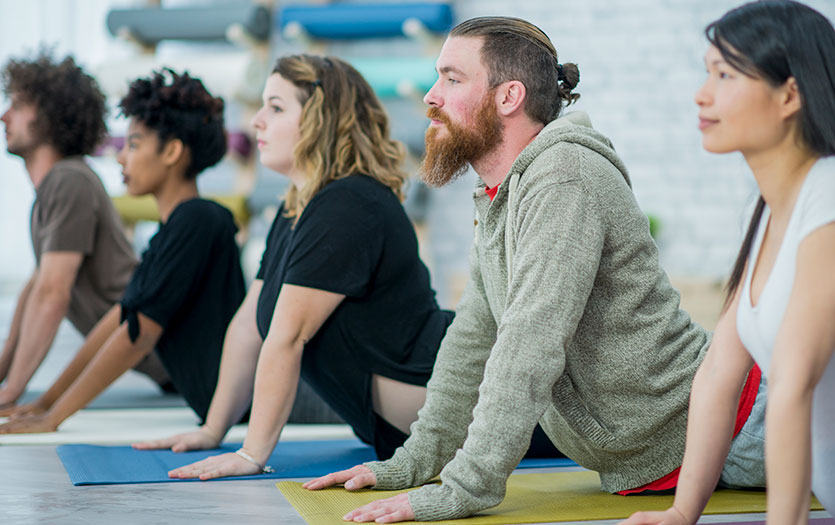
Yoga is a familiar term these days, though not many people know what to expect from the practice. In this post, Amy Moehlenkamp, PA-C, RYT-200, gives us a brief refresher on the whole-body discipline and tips to prepare for class.
Overview
The word yoga is derived from a Sanskrit word that means “to yoke” or “to unite.” It is a practice that connects an individual's body, mind and spirit.
Yoga itself is an ancient philosophical system that involves physical postures, breath practices, meditation and much more to help restore balance within an individual. It is not a religion, and it does not define a deity. While the focus of much yoga practiced in the West is mostly on physical postures, movement is just one of the many aspects of yoga.
Benefits
The ancient system of yoga provides many modern health benefits.
Physical benefits include:
-
Increased flexibility and strength
-
Better posture
-
Reduction of inflammation
The spiritual discipline has also been found to offer mental health benefits such as:
-
Decreasing symptoms of stress, anxiety and depression
-
Improving focus
-
Increasing gratitude
-
Improving sleep quality
Getting started
There are many options to consider when trying to find a yoga class. Names like Vinyasa, Hatha, Restorative, Hot, Yin, Ashtanga, Power, Iyengar and Yoga Therapy may be just a few that you encounter when researching classes. These names usually signify different approaches to yoga, varying in style, focus and intensity.
-
Vinyasa Yoga is a style of yoga during which the student moves through a sequence of postures one breath at a time.
-
Hatha Yoga is focused on individual poses, rather than on transitions between postures. It is considered a bit slower than Vinyasa. Hatha classes can be excellent for beginner classes.
-
Restorative Yoga uses just a few poses per class, during which the student is propped up with bolsters, pillows, blankets, blocks or other sturdy items, such as a chair, to support rest and relaxation.
-
Hot Yoga is practiced in a heated room. Sometimes this means the room is over 100 degrees, so it is important to exercise caution.
-
Yin Yoga involves practicing long holds (3 to 5 minutes) in various seated and reclined poses to access deeper layers of connective tissue and to quiet the mind.
-
Ashtanga Yoga is based on several sequences of poses that remain the same every time.
-
Power Yoga is a fast-paced type of yoga that flows from pose to pose. It can be quite athletic.
-
Iyengar Yoga involves the use of props to pay special attention to alignment in each pose. Poses may be held for extended periods of time.
-
Yoga Therapy uses physical postures and other yogic practices to help empower an individual to progress towards improved health and well-being.
Words you may hear
Yoga philosophy is comprised of many ancient texts. The Yoga Sutras of Patanjali combine several concepts of yoga into a single text that guides a person toward balance through the “8 limbs” of yoga. These limbs are:
-
The Yamas – our relationship to the world around us
-
The Niyamas – our relationship to ourselves
-
Asana – physical postures, our relationship to our physical being
-
Pranayama – our relationship to our breath
-
Pratyahara – our relationship to our senses, turning inward
-
Dharana – concentration
-
Dhyana – meditation
-
Samadhi – super consciousness
What a typical class looks like
Many yoga studios will have you take off your shoes and drop off your personal items before entering the practice space. You may want to inform the teacher of any injuries or health conditions you have so they can help you modify your work during class.
Incorporating different kinds of yoga props can help make the practice more accessible and comfortable. Depending on the class, you may use:
-
A mat to help cushion you and keep you steady as you move through the asana practice.
-
Blocks to assist with proper alignment and to bring the ground closer to you and reduce the risk of injury.
-
Yoga straps to achieve postures safely while reaping the benefits of an advanced pose without injury.
Classes may include more than just the asana; some studios also utilize pranayama (breathwork), mudra (hand gestures) or mantra (chanting). In Sattva Yoga, the type of yoga I teach, each class begins with a grounding awareness practice to help students settle into the present moment. The teacher will then guide students through warm-ups and postures, then invite them to find a comfortable position for final relaxation and/or meditation.
Final thoughts
Thanks to the multitude of tools and modifications available, yoga can be practiced by people with any body type and skill level. If you are considering yoga, I warmly invite you to give it a try. Look for classes described as beginner- or foundational-level, and contact a studio to find the best class for you. I wish you peace and joy in your endeavors.
References
McGuire, D. (2017). Sattva Restore Manual. PranaYoga Institute of Yoga and Ayurveda.
McGuire, D. (2023). 200 Hour Sattva Hatha: Holistic Foundations Program. PranaYoga Institute of Yoga and Ayurveda.
Satchidananda, S. S. (2014). The Yoga Sutras of Patanjali. Integral Yoga Publications.