
This post was written by Jithmie Jayawickrema, PT, DPT, OCS, physical therapist, Parkview Therapy Services.
Shoulder impingement or subacromial pain syndrome is a common, non-traumatic shoulder injury. The subacromial space is defined as the space in between the acromion (part of the shoulder blade) and the top of the head of the humerus. Some of the structures in the subacromial space include your rotator cuff tendons, subacromial bursa, long head of the bicep tendon, etc.
Any of the above-mentioned structures can be involved with subacromial pain syndrome. The reduction of the subacromial space is generally what is believed to be contributing to the pain.
What can contribute to the reduction of the subacromial space?
Some of the factors that can lead to shoulder impingement, include:
- Previous injury to the shoulder
- Postural changes
- Weakness and muscle imbalances in shoulder musculature
- Repeated overhead activity
It’s common in athletes who make overhead movements (volleyball, swimming, basketball, etc.), and those who do work that requires repeated overhead reaching or lifting.
Characteristics of shoulder impingement
Some of the common symptoms reported with subacromial pain syndrome are:
- Onset is non-traumatic
- Pain is progressive in nature
- Location of pain is typically the front and outside of the shoulder
- Painful arc
- Pain usually at the mid-range of shoulder motion
- Pain when laying on affected side
- Weakness in shoulder
Managing shoulder impingement through physical therapy
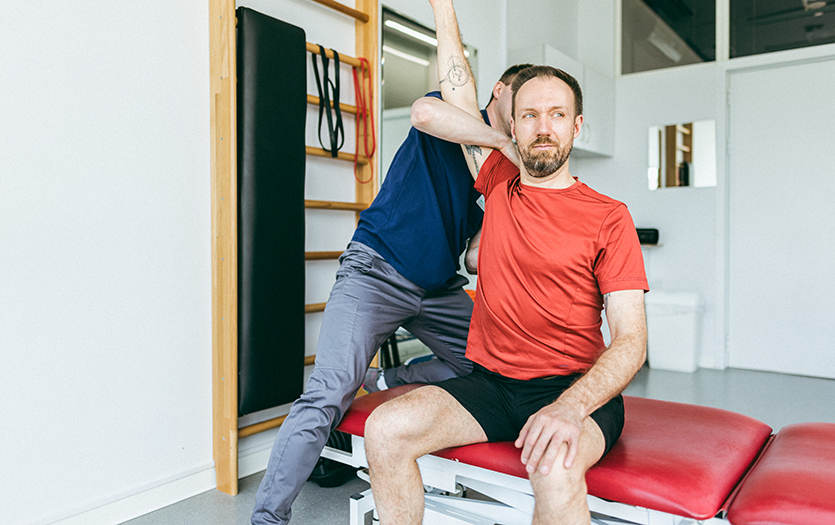
It’s important to work with your therapy services team to develop a care plan that meets your specific goals and needs. This could include:
- A comprehensive assessment is necessary to find the root cause your shoulder pain.
- Manual therapy focusing on shoulder, scapula and thoracic spine mobility.
- Therapeutic exercises focused on shoulder range of motion (ROM) and strength.
- Neuromuscular reeducation to assist with shoulder stability and proper scapula-humeral rhythm.
- Patient education can include:
- Tips of postural awareness during daily activities
- Importance of warming up prior to exercises, work activities
- Taking appropriate breaks especially when engaging in overhead activities
- Advice on proper body mechanics to reduce stress on the shoulder
Remember that gradual return to previous activity is important!
To schedule an appointment with Parkview Therapy Services, visit us here.
References
Current Concepts of Orthopaedic Physcial Therapy. 5th Edition