If you said the emergency room was at the bottom of your summer destination list, we wouldn't be surprised or offended. With warmer weather comes more outside play and, unfortunately, that also means more falls, bumps and tumbles. While we can't compete with amusement parks and beaches, our Emergency Department Nurses at Parkview Regional Medical Center (PRMC) are working to make the ER more pediatric-friendly. The team shared these highlights from the project.
Identifying a need
Historically, at the Parkview Regional Medical Center Emergency Department (ED), adults and children were cared for in the same general care space. There was no age-based separation of patients, and any nurse in the department could care for patients of all ages during their shift.
Audrey Hunnicut, BSN, RN, MBA, CEN, TCRN, Nursing Director ED; Jessica Kater, BSN, RN, TCRN, CPEN, Pediatric Coordinator, PRMC ED; and Rachel Peery, MBS-HM, BSN, RN, CEN, TCRN, Nurse Manager, ED, saw an opportunity to create a more family-centered care environment that prioritizes the unique needs of pediatric patients.
Designing a solution
To get the ball rolling, the group sought input from Monica Fennig, BSN, RN, CEN, TCRN, a clinical nurse in the ED. Monica was a member of the Emergency Nurses Association (ENA) and has 18 years of ED experience. Based on her experience and familiarity with ENA standards for pediatric patients, Monica first recommended investigating adjusting staff volume to achieve a lower nurse-to-patient ratio specifically for pediatric patients.
The general care spaces in the ED typically had a 1-to-4 or 1-to-5 nurse-to-patient ratio. While this approach supported efficient care across the department, it often made it difficult for nurses to spend the necessary time with pediatric patients, assessing, reassessing, performing procedures, improving comfort and educating parents. This shift would allow nurses additional time to meet the pediatric patient’s care needs and provide family support and education.
The ENA position statement related to staffing and productivity states: “ED staffing is based on staff mix of experience and education; patient volumes and acuity; ED input, throughput, and/or output delay; and staff and patient safety.”
With Monica's insights in mind, Audrey, Rachel and Jessica determined that creating a new Pediatric Care Center within the ED was necessary. They developed a vision to create rooms and a care environment that would be friendly, inviting and functional for pediatric patients and their families. Having a Pediatric Care Center would also enhance compliance with other ENA standards related to pediatric readiness, including ensuring the availability of resources, equipment and nurses with pediatric-specific competencies to address the unique needs of this patient population.
Plan in action
From March 2025 through May 2025, Audrey, Jessica, Monica and Rachel met biweekly to operationalize their vision. They first identified an area within the ED to separate the pediatric from the general ED population. This initial step was critical to their success, as it enabled the ED to consistently assign nurses appropriately and to concentrate pediatric equipment and supplies in one area.
The ED administrative team submitted an application and was awarded a grant from the Parkview Health Foundation to purchase comfort items. This included age-appropriate comfort measures, such as coloring books, puzzles, toys, capes, sunglasses, bubbles, fidget toys and even a tablet with distraction applications.
As the project progressed, the team shared their plans with the Parkview Emergency Physicians (PEP) group, as interprofessional collaboration would be important to support this change. They received enthusiastic support for this change from Dr. Tom Gutwein, physician leader for PEP.
They next worked on updating triage guidelines, so the appropriate vital signs were taken at triage, and the pediatric patients could be assigned a bed in the Pediatric Care Center. The team invited Joe Napier, Respiratory Supervisor, and Rebekah Johnson, Respiratory Director, to tour the new area to verify appropriate respiratory supplies were available. The final step was to identify the nurses passionate about working with pediatric patients. This would allow for ongoing pediatric-specific education and competency development.
By June 2025, all pediatric patients began being triaged to the Pediatric Care Center during hours of operation. By grouping all the pediatric patients together, appropriate nurse assignments that met the ENA standard were possible. Also, having a dedicated area with supplies and equipment, improved the readiness of the department, meeting another set of ENA standards.
Feedback and outcomes
Since the changes were implemented in June, patients and families have consistently had better experiences and more satisfaction with their care.
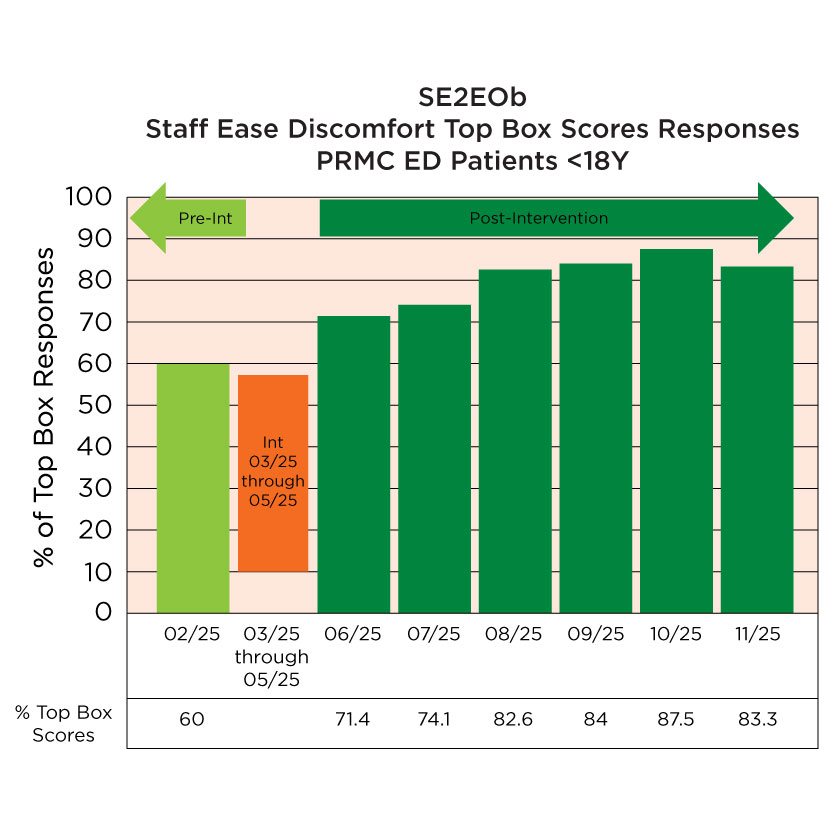
In following patient feedback reports, the "staff eased discomfort" scores for pediatric patients have improved tremendously from 60% in February to 87.5% in October 2025. Improving nurse staffing for pediatric patients and the department's readiness enabled nurses to spend more time providing the specialized care that pediatric patients and their families require.
References
Emergency Nurses Association (2021). Staffing and productivity in the emergency department, pages 1 – 9. file:///C:/Users/e132781/AppData/Local/Microsoft/Olk/Attachments/ooa-c865f854-2677-4c9f-bf81-24d2437e83ee/2a62c4bbf266ae3e73053b0c8df7026d95947056960413e61d5862dbae586b13/69ab6d63a34554a7047f12450b1502924f9de347baf57f921ed5748f639a.pdf
American Nurses Association (2015). Optimal nurse staffing to improve quality of care and patient outcomes: executive summary, pages 1 – 4. file:///C:/Users/e132781/AppData/Local/Microsoft/Olk/Attachments/ooa-c865f854-2677-4c9f-bf81-24d2437e83ee/7adfccc08da786f8ed57079bcc0c8532cde59511744e3497d02310b7857e15d8/ana_optimal-nurse-staffing_white-paper-es_2015sep.pdf