
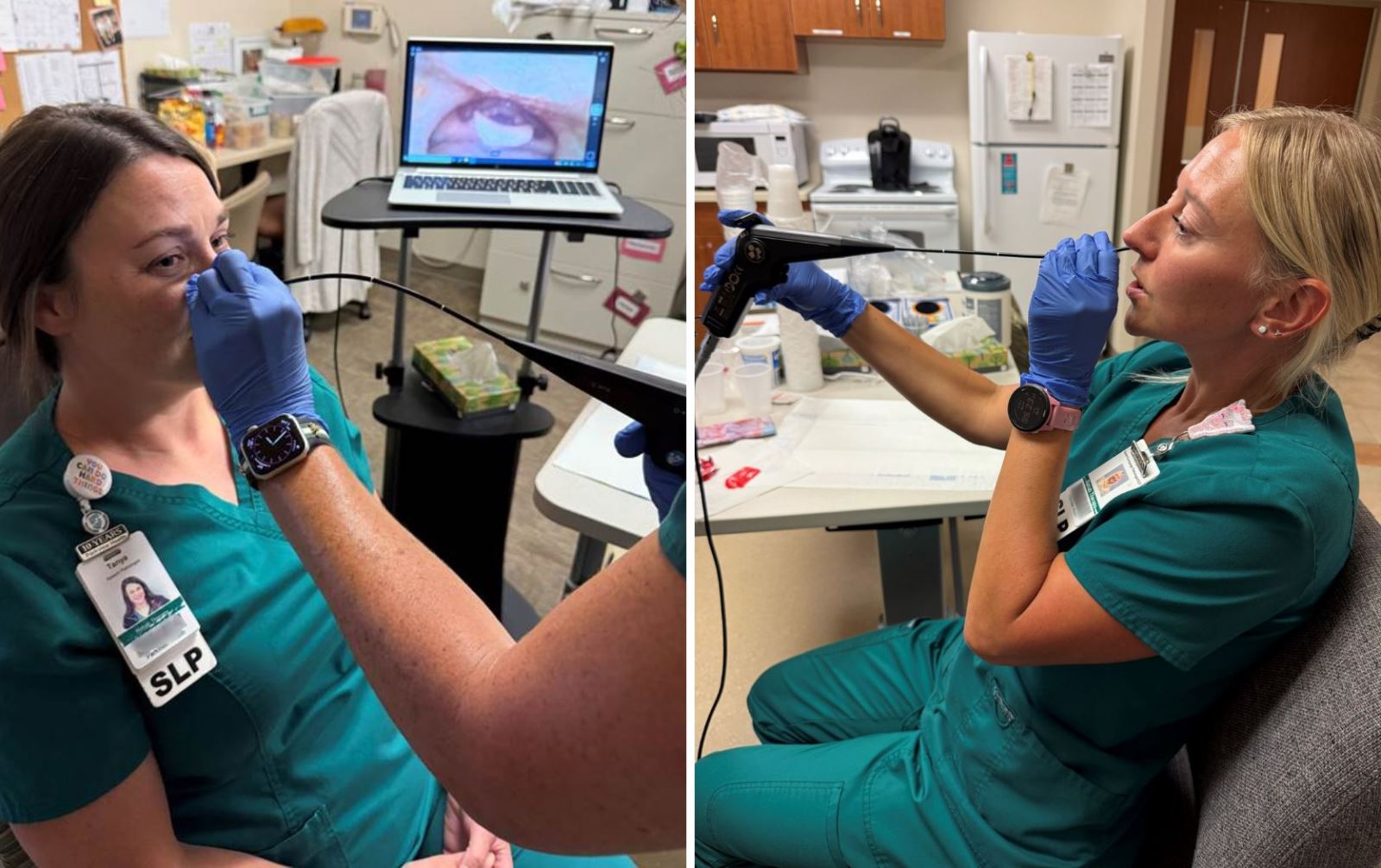
Dysphagia is trouble with chewing, swallowing and airway protection in the oral cavity and pharynx. According to the American Speech-Language-Hearing Association (ASHA), 1 in 25 adults in the United States will experience a swallowing problem each year. Dysphagia can lead to malnutrition, dehydration and weight loss due to difficulty eating if not addressed quickly. In more severe circumstances, it can cause choking and aspiration pneumonia if food or liquid enters the lungs. For patients in critical care settings, early identification of swallowing concerns is essential.
Recently, the Speech and Language Pathologists (SLP) at Parkview Regional Medical Center (PRMC) shared their success in securing a new tool for diagnosing this condition. In this post, Maureen Jeffrey, speech-language pathologist, Parkview Therapy Services, discusses what the process for bringing this device to our community was like and the difference it will make in patient care.
What did it take to launch FEES?
Our team has been working diligently for years to obtain Flexible Endoscopic Evaluation of Swallowing (FEES) for our patients. We are excited to announce that the program is now operational!
This is a huge accomplishment for our team, as obtaining FEES approval can be a long process. It required:
-
Researching and obtaining specialized equipment
-
Navigating logistical challenges, such as securing a safe location for storing and cleaning the equipment
-
Creating protocols and meeting regulatory requirements
-
Obtaining and completing specialized training for the staff
This process, like so many others, was also delayed here at PRMC by the COVID-19 pandemic, but we prevailed!
What is FEES, and how does it work?
FEES is a minimally invasive diagnostic procedure performed by an SLP to assess oropharyngeal (OP) swallowing function. During the procedure, an SLP passes a thin, flexible tube with a camera at the end (an endoscope) through the nose, then views parts of the throat as a patient swallows. The camera captures images of the swallowing muscles and structures, providing detailed information about swallowing coordination and function.
This information is used to identify if there is a swallowing disorder. If there is, it allows them to:
-
Determine the nature and severity of the swallowing dysfunction
-
Suggest diet modifications and strategies to improve swallowing safety and efficiency
-
Plan treatment to improve the swallowing function
-
Provide visual feedback for patients to improve safety and efficiency during the swallowing process
-
Monitor the progress and effectiveness of the treatment plan over time
Before obtaining the FEES, the only other instrumental swallowing assessment tool available at PRMC was the Modified Barium Swallow Study. The test uses X-rays in real time (fluoroscopy) and records what happens when the patient swallows contrast dye. While the MBSS offers a comprehensive view of the swallowing process, it can be less convenient for medically complex patients because it:
-
Can take longer to schedule
-
Requires patients to travel to radiology, which can be challenging for some.
-
Requires exposure to radiation and limits the time available to complete the procedure.
How does the addition of this equipment improve patient care?
Dysphagia is especially concerning for hospitalized patients. Up to 62% of patients recovering from critical illness will experience it, as do up to 78% of stroke patients and up to 65% of individuals with a traumatic brain injury (TBI). Aspiration pneumonia can also be very costly for the American people and hospitals. One study reported a single incidence of aspiration pneumonia costing approximately $30,000 in 2012, with estimates climbing.
This assessment tool is a wonderful addition for patients and their care team at PRMC because:
-
Offers a convenient assessment at the patient's bedside (no need to leave the room)
-
Does not involve radiation
-
Uses real food
-
Allows the SLP to assess swallowing without significant time restrictions
Moreover, bringing FEES to our health system means our patients have access to more options for thorough evaluations and individualized care.
To learn more about the speech therapy program at Parkview, visit our us here.